Independent evaluation · The Research & Insights Lab (TRAIL) · 2026

Design school for the students furthest from opportunity, and every child rises.

All Means All is a 15-month leadership fellowship that coaches teams of school and district leaders to redesign their schools around the students furthest from opportunity, including students with disabilities and multilingual learners. An independent evaluation by TRAIL tested whether that premise holds. It does: for the students AMA centers, and for every student in the building.

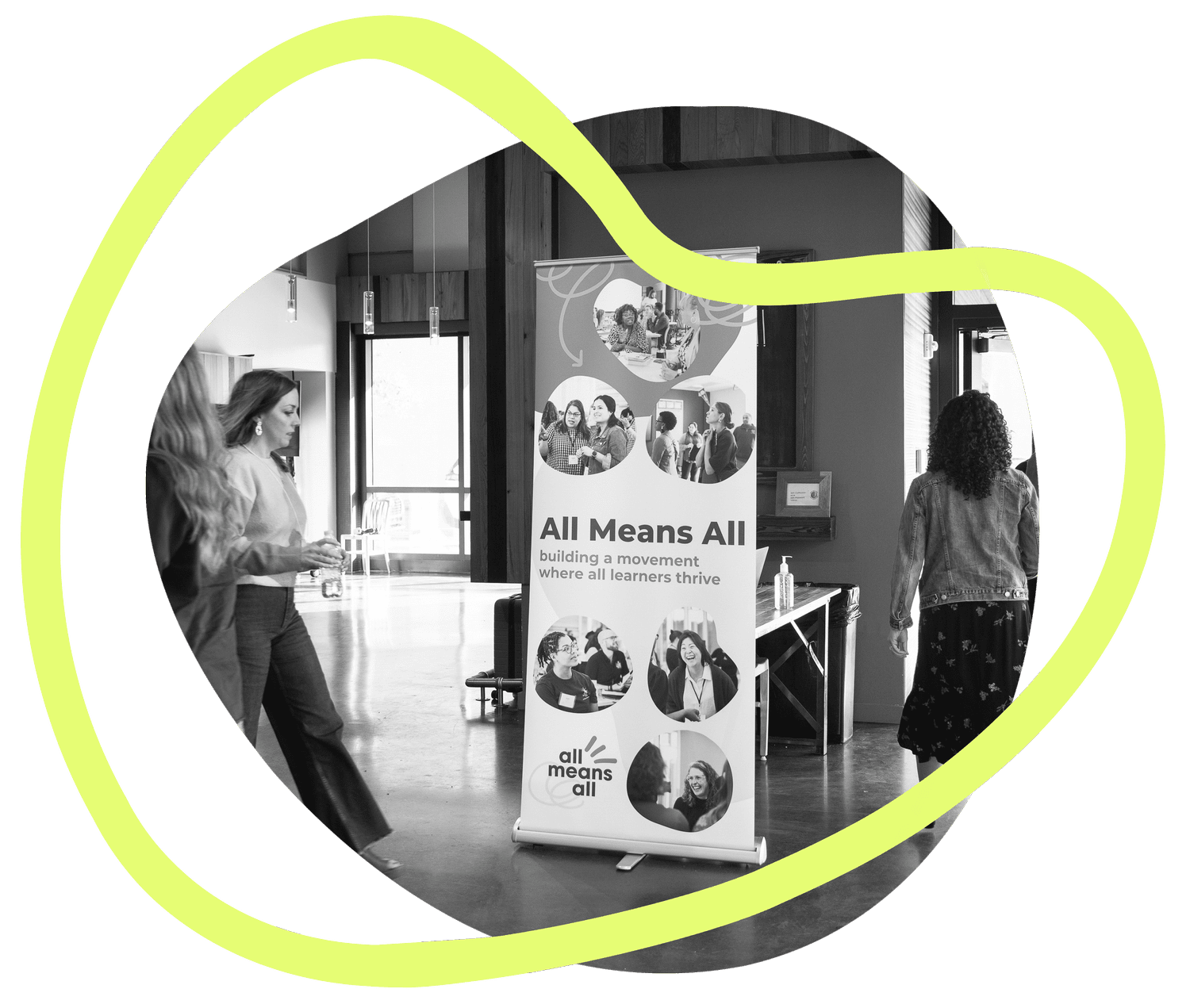
All Means All fellows arriving at a convening, walking past an All Means All banner that reads 'building a movement where all learners thrive.'
  • All students +3.8pp More math-proficiency growth than matched schools, one year after the program Difference: AMA vs. matched schools
  • Students with disabilities +4.1pp Math-proficiency growth, baseline to one year after the program AMA +4.1pp · matched schools +3.2pp
  • Black students +3.83pp Among the study's largest advantages, in math-proficiency growth Difference: AMA vs. matched schools · statistically significant
  • Latino students +5.9pp Math-proficiency growth across the study, the most sustained trajectory AMA +5.9pp · matched schools +3.3pp

Both/and, never either/or

Not a program for some students. A better school for all of them.

Administrators and funders often assume inclusive design involves a trade-off: either you invest in students with disabilities, or you focus efforts on raising achievement for most students first. This evaluation shows that's a false choice. The schools that designed for the students furthest from opportunity saw gains for those students and gains for all students in the same buildings, at the same time.

“…when leadership teams align around those furthest from opportunity, all kids benefit.”

— The Research & Insights Lab (TRAIL), 2026

01 · The Question

Start with the students schools too often design for last.

AMA's theory of action was built on the design principle that the students who often face the steepest barriers (students with disabilities, multilingual learners and others) need the most coherent systems, the same high expectations and the most deliberate support a school can build.

When a leadership team across a school and/or district redesigns instruction, scheduling, hiring and culture so that those students genuinely thrive, it builds a strong school and every learner in the building benefits. That is the research question we set out to explore.

A leader's hands sorting All Means All design cards on a table, including 'Inclusive discipline policy' and 'Accessible, standards-aligned, high-quality curriculum.'

02 · The Study

Independent. Matched. Tracked over time.

  • 35partner schools, grades 3–8
  • 10states
  • 3cohorts of leaders, 2021–2024, tracked pre-, during and post-program
  • Quasi-experimentaldesign: each school compared with similar non-AMA schools
  • 4in-depth case studies of partner systems
  • TRAILindependent evaluator: The Research & Insights Lab

What “quasi-experimental” means, in plain English: TRAIL matched each AMA partner school with demographically similar non-AMA schools, then tracked how both changed over the same years. It is not a randomized trial, but it is promising early evidence, reported honestly.

Outcomes measured

  • ELA proficiency
  • Math proficiency
  • Suspension rates
  • Chronic absenteeism
  • Attendance

Student groups followed

  • Black students
  • Latino students
  • Students with disabilities
  • English learners
  • Economically disadvantaged learners

03 · The Evidence

Four findings, one direction.

Finding 01 · The signal strengthens

Math is the strongest, most consistent signal, and the edge compared to matched schools grows after the program ends.

+2.1ppto+3.8pp

How far AMA's growth outpaces the growth of matched schools: at program end, then one year later

The difference in growth for AMA schools from their baseline year to one year post-program, compared with that of their matched schools, grew from 2.1 to 3.8 percentage points.

As math-proficiency gains remain elusive for many schools, AMA schools are outperforming their peer schools on proficiency growth.

Finding 02 · The both/and

Everyone gains. The students AMA centers gain most.

  • All students +3.8pp AMA's growth from baseline to one year after the program ends outpaces the growth of matched schools. Difference: AMA vs. matched schools
  • Students with disabilities +4.1pp Growth from baseline to one year post-program. AMA +4.1pp · matched schools +3.2pp
  • Black students +3.83pp The difference between AMA schools' growth and that of matched schools, from baseline to post-program, reached statistical significance. Difference: AMA vs. matched schools
  • Latino students +5.9pp Latino students sustained the strongest growth trajectory of the years of the study. AMA +5.9pp · matched schools +3.3pp

One consistent finding: the same schools produced all four results. Everyone gains, and the students the model centers gain most.

Finding 03 · Belonging shows up in the data

Suspensions and chronic absenteeism decrease as achievement rises.

24.7%to10.4%

Black-student suspension rate at Excel Academy (MA), while achievement rose

Cohort 3 schools reduced chronic absenteeism across every student group one year out. Excel Academy (MA) cut Black-student suspension rates from 24.7% to 10.4% while raising achievement.

Fewer students missing school, and fewer being pushed out of it.

Finding 04 · The model is improving

Each cohort is stronger than the last.

Cohort 3 schools outperformed Cohort 2 across math, ELA, and chronic absenteeism, reflecting AMA's shift toward team-based enrollment and deeper problem-solving support.

The program isn't just working; it's learning.
04 · The Schools

Four systems. Four transformations.

TRAIL examined four systems: a dual-state charter network, a traditional public district, a deeply engaged charter management organization, and an early-stage California charter school network. The case studies show how the gains happen: leaders build shared belief, set concrete goals for real students, and redesign their schools around those furthest from opportunity.

The All Means All team together at a convening, seated and standing in front of a greenery wall, holding cards that read 'what's ideal?', 'this is the place', 'think expansively' and 'progress over perfection.'

Excel Academy

Charter network · Massachusetts & Rhode Island. At a post-COVID low point, the network realized it needed more than shared goals; it needed shared values.

Students-with-disabilities math proficiency, more than doubled
5.7% to 12.1%
Staff lost through misalignment not uncovered in the hiring process
~10/yr to 2/yr

Central Falls · Calcutt Middle School

Traditional public district · Rhode Island. From the bottom of the state rankings, the district redesigned its schedule to fully integrate students with disabilities.

Math proficiency, closing the gap with peer schools
2.6× increase

LEAD Public Schools

Charter management organization · Tennessee. Staff lost during COVID, a hunger for shared norms, and AMA's deepest, longest-running partnership.

Chronic absenteeism at LEAD Academy High, while peer schools held above 44%
42.0% to 16.7%

Environmental Charter Schools

Small network · California. A stated commitment to inclusion hadn't yet changed daily practice, until it did.

Gardena-campus math-proficiency growth, vs. +3.4pp for peer schools
+11.4pp
Staff retention, having cleared the state's Differentiated Assistance list in one year
~96%

05 · How It Works

Six moves that show up everywhere it works.

Across all four systems TRAIL studied, the same pattern appeared: build belief before strategy, then hold the work to concrete goals for real students.

Three school leaders in conversation in a hallway during an All Means All convening.
  1. Executive commitment & multi-team depth

    The systems that adopt AMA most deeply commit at every level across school and central teams, often over multiple years.

  2. Shared adult belief before technical strategy

    Every system built adult mindset and culture first, and leveraged it to make the technical strategy stick.

  3. Concrete, disaggregated goals

    Growth and proficiency goals set across specific student groups with real students, not averages.

  4. Bright-spotting as the practice engine

    Leaders convert data into momentum, spreading what already works to solve the next challenge.

  5. Mission-aligned hiring & recruitment

    Systems redesigned hiring around mission fit so that misaligned staff chose to leave, and retention ultimately improved.

  6. Coaching as the anchor

    Leaders across all four systems independently named AMA coaching as the relationship that sustained them.

06 · The Bottom Line

Promising early evidence and growing stronger.

Across the whole study, 13 of 15 statistically significant results favor AMA schools, and 12 of 13 significant achievement gains appeared a full year after the program ended.

“AMA's effects are real but still emerging, strongest in math achievement and among historically underserved students, and growing stronger as the model matures. The case studies show how those gains happen — when leadership teams align around those furthest from opportunity, all kids benefit.”

— The Research & Insights Lab (TRAIL), 2026

07 · Read the Research

Take the evidence with you.

The 2-page summary

“Building Early Evidence”: a short summary of TRAIL's evaluation, prepared for busy partners. One click, no forms.

Download the summary (PDF)

The full evaluation report

TRAIL's complete reports: “Evaluation of AMA's Equitable School Leadership Program” (March 2026) and “All Means All Case Studies” (June 2026).

Full report coming soon

Full reports are available on request: info@amaleaders.org

Help build the next chapter of impact and evidence.

All Means All is scaling a model that lifts the students schools too often design for last, and in turn every student alongside them. Partner with us to deepen the work and strengthen the research.